

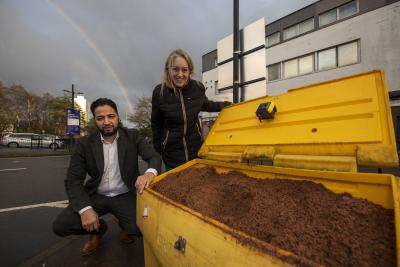
The sensors are being tested at select locations and could also help save time and money by helping to identify trends informing more efficient refilling routes.
Grit bins across the city have once again been replenished over the last week ready for the next cold snap. The council currently provides more than 260 grit bins, for use by residents.
Councillor Qaiser Azeem, Cabinet Member for City Transport at City of Wolverhampton Council said: “We are in the early stages of testing this technology, but the sensors will be a useful tool in helping us monitor the use of grit bins in the city.
“By using the data provided by the sensors, we will be able to focus resources where they are most needed, helping to ensure the safety of residents.”
Councillor Jeszemma Howl, Cabinet Member for Governance and Digital at City of Wolverhampton Council, said: “As a digitally driven council we are always looking for ways to use technology to improve service delivery and quality of life for city residents. This is a great way to do that.”
The council’s gritting crews have already covered more than 8,600 miles in Wolverhampton this winter spreading about 2,150 tonnes of rock salt – often throughout the night. They continue to be on standby 24/7.
With around 480 miles of road in Wolverhampton, gritters cannot treat the entire highways network, and they do not grit footways – they focus on key roads known as priority 1 and 2 routes.
Residents are encouraged to make use of grit bins in their streets and anyone can make a request for a grit bin, or a refill, via Grit bins.
Find out more about gritting and priority 1 and 2 routes via Gritting – is my road being gritted?